Integrating physical, engineering and social sciences to construct a framework for assessing effectiveness and side effects of geoengineering proposals.
The IAGP project was funded from October 2010 to February 2015.
IAGP Research: What have we learned?
Our key findings are presented in a series of Briefing Notes:
- Briefing Note 1, Evaluating geoengineering as a potential response to climate change: What needs to be considered?
- Briefing Note 2, Public and other stakeholder perceptions of geoengineering: Facilitating responsible innovation
- Briefing Note 3, Decision-making for geoengineering: Why will it be challenging?
- Briefing Note 4, Practicalities of geoengineering: Could the devil be in the detail?
- Views About Geoengineering: We have also produced a special feedback briefing note for members of the public that outlines the key outcomes of our public engagement.
IAGP News
In this latest study, published in the Journal of Geophysical Research: Atmospheres, IAGP researchers Julia Crook and Lawrence Jackson consider how effective different Earth radiation management schemes are at counteracting global warming. Read more.
February 2015: Not enough time for geoengineering to work?
In his latest article in the Bulletin for Atomic Scientists, IAGP Principal Investigator and IPCC Lead Author, Piers Forster describes the research and conclusions drawn from IAGP’s examination of geoengineering technologies over the past four years. Read more
January 2015: Could we Restore Arctic Sea Ice with Geoengineering?
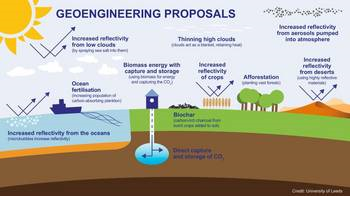
In a paper just published in Geophysical Research Letters IAGP researchers perform a novel simulation where we see if it is possible to restore Arctic sea-ice using stratospheric aerosol injected by planes flying out of Svalbard. More
January 2015: Forcing, feedback and internal variability in global temperature trends
In this latest study, published in Nature, authors Piers Forster (IAGP Principal Investigator) and Jochem Marotzke, MPI, compared climate observations with simulated 15-year trends over the period 1900-2012. The research concluded that the claim that climate models systematically overestimate the response to radiative forcing from increasing greenhouse gas concentrations seems unfounded. More
For full stories and all IAGP news
Watch our Principal Investigator Professor Piers Forster describe the main findings of the Integrated Assessment of Geoengineering Proposals (IAGP) project:
Geoengineering Research: Where Next?
On 26th November 2014, three UK geoengineering research projects, IAGP, SPICE and CGG, held a joint event, Geoengineering Research: Where Next?, at The Royal Society in London to disseminate our research findings.
Read the press release for the dissemination event.
Watch the key speakers' presentations and view the slides.
Browse some of the media responses to our research
- NewScientist: Geoengineering the planet: first experiments take shape
- BBC News: How could we intervene to change the climate?
- The Economist: Geoengineering the climate: Into the great wide open
- The Times: Scientist terrified by his own climate-cooling plan
- The Telegraph: Six radical ways to tackle global warming
Further Information
Read through our archive of IAGP news articles. Find out more about geoengineering. Find out more about who we are. Find out more about our research.
For further information on the UK based SPICE and CGG geoengineering research projects: